
Canadian Stamps Explained: P Stamps, Postage Meters, Indicia and More
Not sure what the P on a stamp means, whether an old stamps still work, or what that printed box on your bill is? Here's a plain guide to Canadian stamps and postage marks.
Updated · 13 min read

You have a letter ready to go, and you are wondering: which stamp should I use? Then you notice the stamp in your drawer, it shows a "P" where the price should be. Or the envelope from your bank has no stamp at all, only a printed box.
Canadian postage is simpler than it looks. This guide covers every kind of stamp you can buy, what each one is for, and what the other postage marks on your mail mean.
Prices below are Canada Post's consumer prices before tax, checked in November 2026. We're not affiliated with Canada Post.
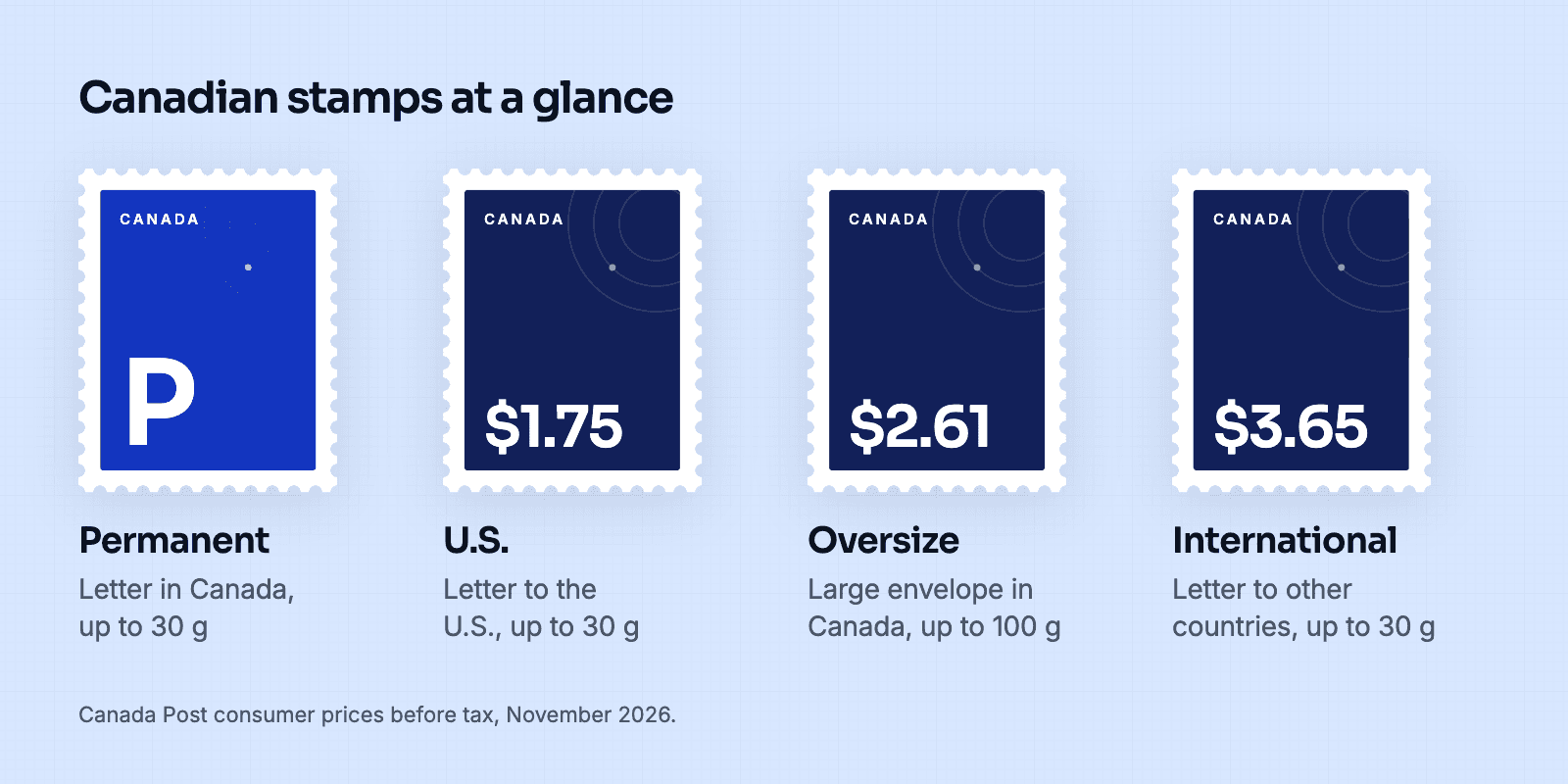
Canadian Stamps at a Glance
There are four stamps most people ever need. Which one you use depends on where the letter is going, how big the envelope is, and how much it weighs.
| Stamp | What it covers | Price |
|---|---|---|
| Permanent (P) | A regular letter in Canada, up to 30 g | $1.24 in a booklet, $1.44 single |
| $1.75 (U.S.) | A regular letter to the U.S., up to 30 g. Also a regular letter in Canada from 30 g to 50 g | $1.75 |
| $2.61 (oversize) | A large envelope in Canada, up to 100 g | $2.61 |
| $3.65 (international) | A regular letter to any other country, up to 30 g | $3.65 |
A "regular" letter is what Canada Post calls standard size. It's no bigger than 245 mm by 156 mm, no thicker than 5 mm, and no heavier than 50 g. A normal business envelope or greeting card fits easily.
Anything bigger or heavier is a large (oversize) envelope. Those can be up to 380 mm by 270 mm, 20 mm thick, and 500 g. Past 500 g, it has to go as a parcel. If you're sending one, our guide on how to address a large envelope covers the layout.
Not sure about the weight? Canada Post's rough guide is that 30 g is about 5 sheets of paper and 50 g is about 9 sheets. For the exact postage and how many stamps to put on, use our stamp calculator. The letter weight estimator works out the weight from your page count. You can also check Canada Post's postage rates page for the full price list.
The Permanent (P) Stamp
This is the stamp most people need. Where other stamps show a price, it shows the letter P.
A Permanent stamp always pays for one regular letter (up to 30 g) mailed anywhere in Canada. It doesn't matter when you bought it or what you paid for it. Canada Post first sold Permanent stamps in November 2006, when mailing a letter cost 51 cents. One of those stamps will still mail a letter today.
Permanent stamps never expire.
What you pay for that letter depends on how you buy the stamp:
- $1.24 each in a booklet, a coil (a roll) or a pane (a sheet). A booklet of 100 costs $124.
- $1.44 if you buy just one stamp at the counter.
Same letter, same delivery. The only difference is how many stamps you buy at once, so a booklet saves you 20 cents on every letter. One small detail: the single stamp sold at the counter has $1.44 printed on it where the P would be. It does the same job.
Tip: stamps cost less at Costco. If you mail a lot and have a Costco membership, look for stamps at the warehouse. At the time of writing, Costco sells a roll of 100 Permanent stamps for $118.90 before tax. That's about $1.19 a stamp, and $5.10 less than the same roll from Canada Post ($124.00). Prices can change, and Costco's same-day delivery site charges more, so this one is worth picking up in person.
One more thing to know. If you put a Permanent stamp toward bigger postage, like a heavier letter or one going abroad, Canada Post counts it as $1.24. Our stamp calculator shows the current value of a Permanent stamp and how many you'd need for any letter.
Stamps With a Price Printed on Them
Other Canadian stamps show a dollar value, and that value never changes. These are the ones you'll see most:
- $1.75. Sold as the U.S. stamp. It covers a regular letter to the United States (up to 30 g). It's also the exact price of a regular letter within Canada that weighs 30 g to 50 g.
- $2.61. Sold as the oversize stamp. It covers a large envelope within Canada, up to 100 g.
- $3.65. Sold as the international stamp. It covers a regular letter (up to 30 g) to any country other than the U.S.
- Small values, from 1 cent to 25 cents. These exist to top up postage when you're a little short.
- $1, $2, $5, $8 and $10. High-value stamps for heavy envelopes and parcels.
The $1.75, $2.61 and $3.65 stamps come in booklets of 6 and coils of 50.
The names are only labels. A stamp is prepaid postage, and Canada Post accepts any mix of stamps as long as the total covers the price. So a "U.S." stamp works fine on a letter within Canada, and Permanent stamps can go on a letter to France. You can pay too much, but never too little. That's why our calculator is handy, because some time it can get tricky to find the best combination of stamps based on which one you have in stock.
Same Postage, Different Pictures
Canada Post brings out new stamp designs all year. You may hear a few names for them:
- Definitive stamps are the everyday ones. They're printed in large numbers and stay on sale for a long time.
- Commemorative stamps come out in limited runs to mark people, events, holidays and anniversaries.
- Fundraising stamps come out once a year for the Canada Post Community Foundation. A booklet of 10 costs $1 more than a regular booklet, and that dollar goes to programs for children and youth.
The picture doesn't change what the stamp is worth. A Christmas P stamp and a flower P stamp do the same job, and you can use either one in any month of the year.
Stamps also come in a few formats:
- A booklet usually holds 6 or 10 stamps
- A coil is a roll of 50 or 100
- A pane is a flat sheet
- A souvenir sheet is a small decorative sheet made for collectors, though the stamps on it are still real postage.
What about stamps with your own photo on them? Canada Post used to offer those under the name Picture Postage, but it retired the program in September 2022.
Do Old Stamps Still Work?
Found a few old stamps in a drawer? Good news: Canadian stamps don't expire.
- An old P stamp still covers a regular letter in Canada, no matter what you paid for it.
- An old stamp with a printed value is worth exactly that value. A 63-cent stamp is still worth 63 cents.
To use stamps with a printed value, add them up until you reach the postage you need. A regular letter needs $1.24, so a 63-cent stamp needs another 61 cents beside it. Small-value stamps from the post office fill the gap. If you aren't sure you've added enough, a post office clerk can check the envelope for you.
Sending something heavier, or mailing outside Canada? Our stamp calculator works out how many stamps to use and finds the cheapest mix from the ones you already have.
There are a few stamps Canada Post won't accept. A stamp doesn't count if it is:
- torn or damaged
- dirty
- covered with tape or anything see-through
- drawn on or marked up
- already used
- from another country
So don't tape over a stamp to help it stick, and don't peel one off an envelope that has already been through the mail.
Stamps go in the top right corner on the front of the envelope.
Postage That Isn't a Stamp
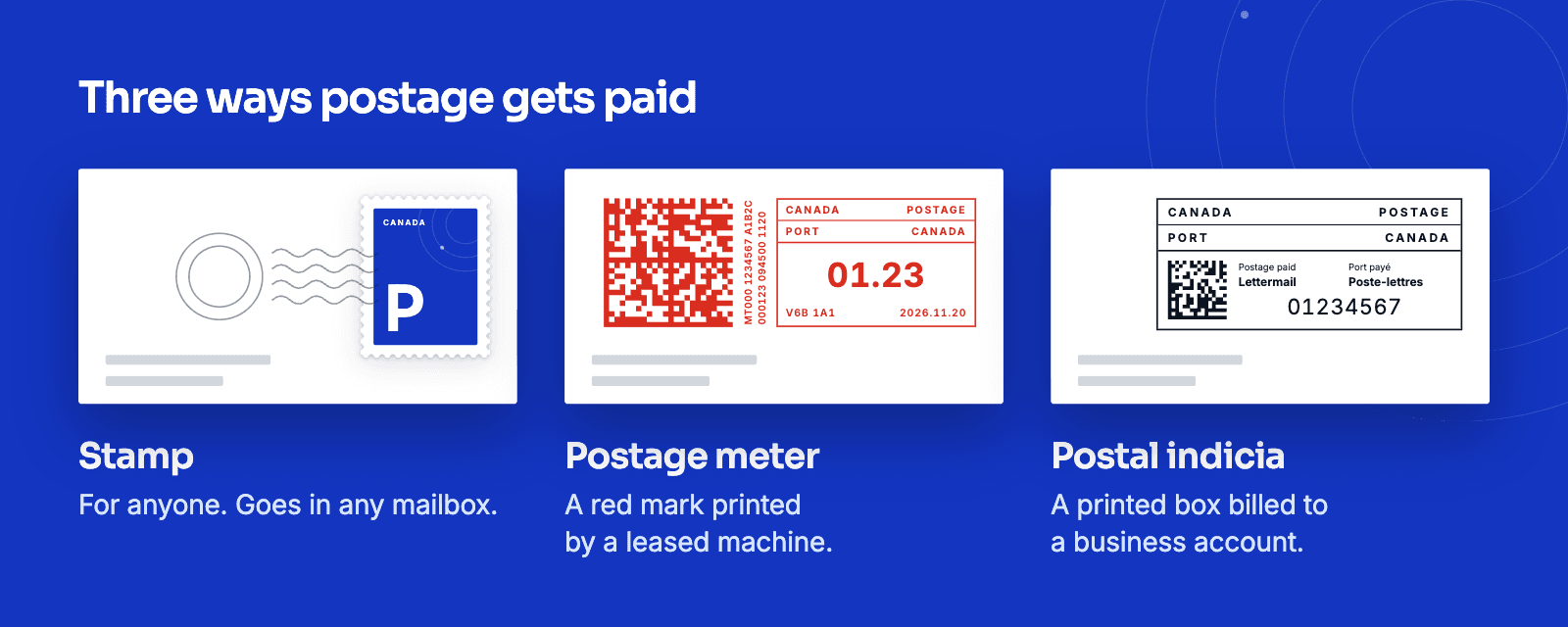
Plenty of mail gets delivered with no stamp on it at all. Here's what you're looking at.
Postage-Paid Envelopes
Canada Post sells business-size (No. 10) envelopes with the postage already printed on them. One costs $1.60, and a pack of 10 costs $13.60. Write the address, seal it and mail it.
For faster delivery there are also flat-rate Xpresspost prepaid envelopes. The price includes postage and tracking and can require a signature on delivery as an add-on.
Postage Meters
Have you seen a red printed mark in the corner of a business envelope? That's a postage meter impression, and the envelope is what's called metered mail.
A postage meter is a machine that prints the exact postage straight onto an envelope or a label. Offices that send a lot of mail use one so they don't have to stick on stamps by hand.
- Who can use one: businesses lease a meter from a supplier approved by Canada Post. There are three: FP (Francotyp-Postalia), Quadient and Pitney Bowes.
- What it looks like: a mark printed in bright red ink that shows the amount of postage paid.
- What the postage costs: the metered rate for a regular letter up to 30 g is $1.23. That's one cent less than a booklet stamp and 21 cents less than a single stamp. Heavier letters and large envelopes within Canada cost the same as they do with stamps.
- What the machine costs: lease prices vary by supplier and plan, so ask for a quote.
- What it can't do: meters are for letters. Parcels need a shipping label but some postage meter machine comes with a label printer as well.
Metered mail can go in any street mailbox, just like stamped mail.
The saving on each letter is small if you already buy stamps in booklets. For most offices, the real benefit is speed and easy record keeping.
Postal Indicia
A postal indicia is the printed box you see on bills, bank statements and flyers that are addressed to you. It shows the name of the mail service and the sender's Canada Post customer number. It doesn't show a price.
Think of it as a business telling Canada Post, "Charge this mail to my account."
- Who can use it: businesses with a Canada Post business customer number.
- How it works: the business downloads the indicia artwork from Canada Post and prints it on every envelope. Then it fills out an online order that says how many pieces it's mailing, and pays by credit card or on its account.
- Where it gets mailed: indicia mail must be dropped off at an approved Canada Post location. It can't go in a street mailbox.
- What it costs: $1.24 for a regular letter up to 30 g, the same as a booklet stamp. Mailings of 1,000 or more letters that sorting machines can read get a slightly lower price of $1.23.
Canada Post explains the steps on its postal indicia page.
Business Reply Mail
This is the reply envelope a charity or company sends you so you can answer without a stamp. It usually carries the words "Postage paid if mailed in Canada."
The organization pays an annual fee, and then pays postage only for the replies that people actually mail back.
For you, it's simple. Seal it and drop it in a mailbox. As the wording says, it's only prepaid when you mail it from inside Canada.
Side by Side
Type of postageWhat it looks likeWho uses itRegular letter in Canada (up to 30 g)Where you can mail it
| Type of postage | What it looks like | Who uses it | Regular letter in Canada (up to 30 g) | Where you can mail it |
|---|---|---|---|---|
| Stamp | A sticker with a P or a price | Anyone | $1.24 from a booklet, $1.44 single | Any mailbox or post office |
| Postage-paid envelope | A stamp printed on the envelope | Anyone | $1.60, envelope included | Any mailbox or post office |
| Postage meter | A red printed mark with the amount | Offices that lease a meter | $1.23 | Any mailbox or post office |
| Postal indicia | A printed box with a customer number | Businesses with a Canada Post account | $1.24 | Canada Post drop-off locations only |
Do Registered Mail and Xpresspost Need a Special Stamp?
No. Registered Mail isn't a kind of stamp. It's a service you add on top of regular postage.
Within Canada, the Registered Mail fee is $13.15 plus the postage for your letter. In return you get proof that you mailed it and a signature when it's delivered. You have to hand a registered letter in at a post office. It can't go in a street mailbox.
Xpresspost is a separate, faster service with tracking. It has its own prepaid envelopes and labels.
If you're not sure which service fits your letter, our guide to Canada Post mailing options compares them.
What Happens If You Don't Use Enough Postage?
A letter without enough postage doesn't just get delivered anyway.
Canada Post can send it back to you, which is one good reason to always write a return address. Or the person you sent it to may be asked to pay what's missing before they can have it. Canada Post's price list sets that charge at the missing postage plus a $1.24 fee.
Either way, your letter arrives late. When you're unsure, weigh it first or just send it with Online-Post.ca.
Where to Buy Stamps
You have a few options:
- Any post office. There are more than 6,200 across Canada.
- Canada Post's online store.
- Authorized retailers. Many pharmacies, grocery stores and convenience stores sell booklets.
- Costco, for rolls of 100 (see the tip above).
Stamp prices are listed before tax, so expect GST on top.
Be careful with big discounts online. Collectors have reported fake Canadian stamps for sale on large marketplace and auction sites, priced well below face value. A few dollars off a roll at a store you know is normal. Half price from a stranger online is not.
And if you'd rather not deal with stamps at all, you can mail your letter online and Online-Post.ca will print it, put it in an envelope and mail it for you.
Frequently Asked Questions
Do Canadian stamps expire?
No. A Permanent (P) stamp covers a regular letter in Canada no matter when you bought it, and a stamp with a printed value keeps that value. The stamp just needs to be unused and in good shape.
Can I still use old stamps that show a price?
Yes. Each one is worth the amount printed on it. Add stamps until the total covers today's postage, and use small-value stamps from the post office to fill any gap. Paying a little too much is fine. Paying too little is not.
Is metered mail cheaper than stamps?
A little. A regular letter up to 30 g costs $1.23 with a meter, compared with $1.24 for a booklet stamp and $1.44 for a single stamp. Heavier letters and large envelopes within Canada cost the same either way. The meter also has to be leased, so it mostly makes sense for offices that send a lot of mail.
What is the difference between a postage meter and a postal indicia?
A postage meter prints the exact postage on each envelope, and that mail can go in any mailbox. A postal indicia is a printed box with the sender's Canada Post customer number. The business pays for the whole mailing through an online order and has to drop it off at a Canada Post location.
What does "Postage paid if mailed in Canada" mean?
It means the envelope is Business Reply Mail. The organization that sent it to you pays the postage when you mail it back, so you don't need a stamp as long as you mail it from inside Canada.
Can I reuse a stamp that was never postmarked?
No. A stamp pays for postage once. Canada Post doesn't accept stamps that have already been used, and the same goes for stamps that are torn, dirty, drawn on or covered with tape.