
How to Correctly Address a Large Envelope
When you're sending important documents through Canada Post, even small addressing mistakes can mean costly delays, returned mail, or lost paperwork. And when it comes to large envelopes (officially called Oversize Lettermail), the stakes are usually higher: these are the envelopes carrying contracts, tax filings, legal documents, immigration paperwork, and other materials you can't afford to lose in the mail.
The good news? Canada Post has clear, specific rules for addressing large envelopes, and once you know them, the process becomes simple.
This guide walks you through exactly how to address a large envelope in Canada, with the proper placement for the recipient address, return address, and postage, plus the common mistakes that cause most delivery problems. So we are sure your letter will reach its destination!
Why Proper Addressing Matters for Large Envelopes
Canada Post uses automated sorting equipment that scans envelopes at high speed. When the address is correctly placed and formatted, your envelope moves smoothly through the system. When it isn't, several things can happen:
- Your envelope is pulled aside for manual sorting, adding days to delivery
- The postage placement triggers automated rejection
- The address can't be read, and the envelope is returned to sender
- Critical documents arrive late, missing legal deadlines or filing windows
Large envelopes often carry time-sensitive materials, so even a one-week delay can have real consequences.
Before You Address: Make Sure It's Actually a Large Envelope
A "large envelope" in Canada Post's system refers to Oversize Lettermail. To qualify, your envelope must meet these limits:
- Maximum dimensions: 380 mm × 270 mm × 20 mm
- Maximum weight: 500 g
- Contents: Flat, flexible paper documents only
If your envelope exceeds these limits, or contains rigid items, it must be sent as a parcel instead, which uses a different addressing format and costs significantly more. Be don't worry, when you use Online-Post.ca for your mailing, we will handle everything as expected by Canada Post, so no mistake possible!
Step 1: Orient the Envelope Correctly
Before writing anything, make sure your envelope is positioned the right way:
- Place the envelope horizontally (landscape format)
- The longer edge should run left to right
- The flap should be on the back, facing down
This orientation matches what Canada Post's sorting machines expect, and getting it wrong from the start makes every other step harder to do correctly.
Step 2: Position the Recipient's Address
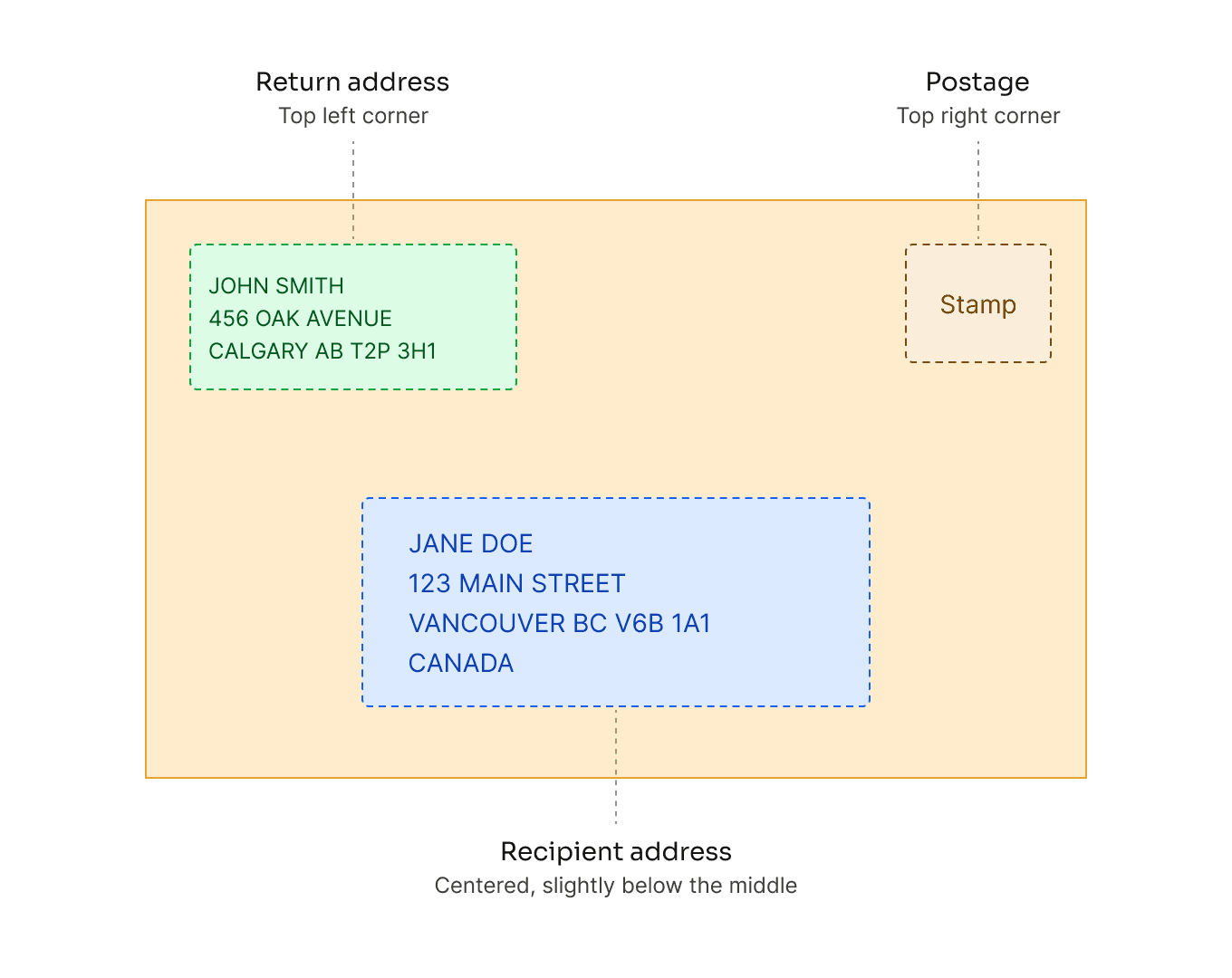
The recipient's address is the most important element on the envelope, and Canada Post has precise rules for where and how it appears.
Placement
- Centered horizontally across the envelope
- Positioned slightly below the middle vertically
- Leave at least 19 mm of clear space on all sides
Formatting
- Use block letters (all uppercase)
- No punctuation — no commas, no periods
- Single spacing between lines
- Use the official two-letter province abbreviation (BC, ON, QC, AB, etc.)
- Two spaces between the province and the postal code
Standard Format
RECIPIENT NAMESTREET ADDRESSCITY PROVINCE POSTAL CODECANADA
Example
JANE DOE123 MAIN STREETVANCOUVER BC V6B 1A1CANADA
If you're sending to a business or organization, include the company name on a separate line above the street address. For apartments or suites, place the unit number before the street number, separated by a hyphen (for example, 302-123 MAIN STREET).
Step 3: Add the Return Address
The return address goes in the top left corner of the envelope. It uses the same formatting rules as the recipient address: block letters, no punctuation, and the same line order.
Why this matters: if your envelope can't be delivered, Canada Post will send it back to the return address. Without one, undeliverable mail goes to a dead mail processing centre, and you may never see it again. So it's always better to include it.
Example
JOHN SMITH456 OAK AVENUECALGARY AB T2P 3H1CANADA
A common mistake is to write the return address too large or too close to the recipient address. Keep it compact and well-separated from the centre of the envelope so the sorting machine reads the destination, not the origin.
Step 4: Place the Postage
Postage goes in the top right corner of the envelope. This placement is essential because automated sorting machines scan that exact area looking for postage value.
If your stamp or postage label is placed:
- In the centre of the envelope
- Overlapping the address
- On the back
- Too close to the edge
…the envelope may be flagged as having insufficient or missing postage, and delivery will be delayed or refused.
For large envelopes, postage is calculated based on weight and destination (within Canada, to the USA, or international). Make sure you're using the correct postage value before mailing, under-stamped mail is one of the most common reasons large envelopes get returned. Use our tool to estimate the postage price as well as which stamps to use. Or, you can send your large envelope through Online-Post.ca: postage is calculated automatically based on your document, so there's no risk of under-stamping. We'll take care of it!
Common Addressing Mistakes to Avoid
Even people who mail documents regularly make these mistakes. Avoid them and your envelope will move through Canada Post's system without friction.
- Using cursive or stylized fonts. Automated sorters struggle with anything that isn't clear block letters.
- Adding punctuation. Canada Post recommends omitting commas and periods entirely.
- Mixing uppercase and lowercase. All-caps is preferred for both addresses.
- Forgetting the postal code. Without it, your envelope can't be machine-sorted.
- Using the wrong province abbreviation. Always use the official two-letter code.
- Putting tape over the address. Reflective tape interferes with scanning.
- Crossing out text or writing over mistakes. Use a fresh envelope instead.
- Skipping the return address. Without one, undeliverable mail is effectively lost.
- Placing postage in the wrong corner. Always top right.
Addressing International Large Envelopes from Canada
If you're mailing internationally, the same rules apply, with two key differences:
- The country name must appear on the last line, in English, in all caps (for example,
UNITED STATES OF AMERICAorFRANCE) - The postal code format will match the destination country's standard, not Canada's
For example, a large envelope going to the United States might be addressed:
MARY JOHNSON789 ELM STREETSEATTLE WA 98101UNITED STATES OF AMERICA
The return address still uses the standard Canadian format.
Skip the Hassle: Mail Large Envelopes Online
Even with the rules clearly laid out, addressing a large envelope still means buying the right envelope, printing or writing the addresses by hand, weighing your documents, calculating the correct postage, and getting to a post office before it closes.
If you'd rather skip all of that, Online-Post.ca lets you send large envelopes entirely online. You upload your document, enter the recipient's information, and we handle the printing, envelope preparation, addressing, postage, and mailing, all without you leaving home.
It's the easiest way to send important documents in Canada, especially when you're mailing multiple pages or sending to several recipients at once.
Frequently Asked Questions
Can I handwrite the address on a large envelope? Yes, but only if your handwriting is clear, in block letters, and easy to scan. Printed labels are more reliable for automated sorting and reduce the chance of delivery errors.
Do I need to include "CANADA" on domestic addresses? For mail staying within Canada, the country line is technically optional, but it's recommended on large envelopes to avoid any confusion, especially if your envelope might be mistakenly routed as international.
What happens if I forget the return address? If your envelope can't be delivered and has no return address, it's sent to Canada Post's dead mail processing centre. In most cases, you won't get it back.
Can I use a window envelope for a large envelope? Yes, as long as the recipient address is visible through the window and meets the placement requirements: centered, slightly below the middle, with clear space around it.
Should I use a printed label or write the address directly on the envelope? Either works, as long as the formatting is correct. Printed labels reduce the chance of unreadable handwriting, look more professional, and are easier for sorting machines to scan.
Is the addressing format different for Registered Mail or Xpresspost? No, the addressing rules are the same. The difference is that those services include tracking and proof of delivery, which is worth considering for important documents.
Skip the post office.
Upload your letter — we print it, stuff the envelope, and mail it across Canada.
- No printer, envelope, or stamp needed
- No subscription, no hidden fees
- Starting at $3 per letter